Today, here in America, we celebrate Independence Day. In our challenging political climate, I cannot help but reflect on how our independence seems so fragile. I think about my dad on holidays such as these, and how he, the proud Marine, lamented that less and less families displayed a flag. As much as I miss him, I am relieved that he is not living through these times because I firmly believe that it would make him physically ill. He would be worried about my future, but at least now he is watching over me.
I also can’t help but think of independence as it relates to ALS.
ALS, or amyotrophic lateral sclerosis, is a progressive neurodegenerative disease that ultimately results in the loss of voluntary muscle action. Patients are affected differently in terms of progression, but people may lose the ability to speak, eat, move and breathe in any order of events. Ben’s initial symptoms were weakness in his legs and lack of balance. Next, he struggled with the use of his arms and hands, then his ability to chew and swallow. His speech was impaired though he did not lose it until he had a tracheostomy, and he got a feeding tube at the same time.
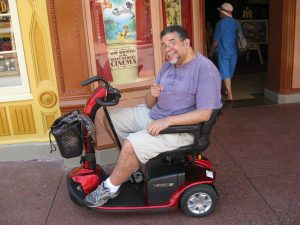
Imagine the loss of all of those abilities that we take for granted. The Project ALS Don’t Talk-a-Thon underscores the physical speech while calling attention to its dramatic impact of a loss of self-expression on our psyches. People with ALS cannot independently take care of daily life activities. That is a physical and emotional struggle. I was always struck by Ben’s sense of humor and determination to devise strategies for managing on his own. He was quick to purchase things like adaptive zipper pulls and computer accessories that allowed him to function at least somewhat independently. He loved his scooter and electric wheelchair because they gave him the freedom to get around and be outside. As he lost dexterity in his hands, it became more difficult for him to steer, but he could be out and about. He tried hard to avoid, for as long as possible, his loss of independence.
As Ben’s caregiver, as he became increasingly dependent on me, I, too, lost independence. This was an emotional battle for both of us. Even within couples and families, each person maintains a certain level of independence. Ben and I lost that independence, albeit in different ways. I could no longer take time for myself. And, I witnessed Ben’s struggle and was consumed with trying to accommodate his efforts to maintain some level of independence. Ben and I were dependent on each other in this world in which our relationship was shifting beyond our control and we desperately wanted to maintain some semblance of who we were at our core, before ALS. After I lost Ben, I was frequently told that it was good that I could now reclaim my freedom. Only now, nearly three years later, am I becoming more comfortable with my independence. Still, I blog and maintain my deep connection to people who are experiencing ALS, as patients or caregivers. My experience left me with some battle scars, but it also left me with a tremendous appreciation of and perspective on independence.
Walt Disney said that “Mickey Mouse is, to me, a symbol of independence.”This was said in the context of the success that it brought him and his company, and the freedom to pursue his dreams. “Independence” is vital to our existence in many literal and figurative ways. On Independence Day, we honor this country and its founding principles. Let’s be grateful for independence. Let’s fight to preserve those values that are currently under attack and being chipped away and could potentially impact on the medical care and research that strives to help make ALS more manageable and, ultimately, to eradicate this cruel disease. In my practical way, I contribute, through donations and the raising of awareness about ALS. In my Disney way, I continue to wish for and dream about a cure for ALS and all other diseases.
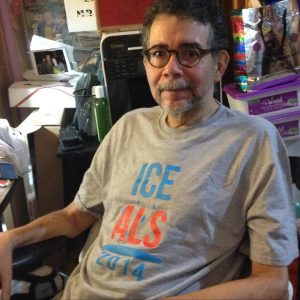
I always picture Ben like this, in his chair at his desk.
Since last week marked the 24th anniversary of the release of The Lion King, of course, I had to watch the film once again. I have always adored Simba but had a hard time with how cruel Scar was and how he actually killed his own brother. Still, the animation is incredible and was yet another stellar achievement by the Disney team. As with so many Disney films, I see different insights and am touched in many ways that reflect my own experiences with caregiving and grief. I’ve written about being “surrounded by idiots” and how it has not always been “hakuna matata.” Now, I’d like to share some of the quotes from the film that resonate with me as a daughter, a wife, a caregiver, and a person who has experienced grief. I’m including photos that Ben and I took at Walt Disney World’s Animal Kingdom.
“Life’s not fair, is it?”- Scar
Scar speaks the simple truth. It’s not fair that our loved ones become ill, suffer and leave us. It’s not fair that caregiving is so difficult. It’s not fair that things like insurance and finances have to be concerns when we are already coping with the physical and emotional devastation of terminal illness. It’s not fair that we don’t always have family that is helpful or caring. But, as loving people, although we may lament and vent about the difficulties we face, we also look for share love and positive influences.
Ben told me that he never asked the question, “why me?” when he was diagnosed with ALS. They were the cards he was dealt. So, I never let myself ask that question either. It wasn’t fair, but we tried to make life as good as we could for as long as we could.
We saw Simba! 2007
“I’m only brave when I have to be.”- Mufasa
I have often written about not feeling brave. Though not from this film, my favorite quote, and the one to which I relate best, is actually from Christopher Robin: “You are braver than you believe, stronger than you seem and smarter than you think.” The fact is that my dad, Ben and I were brave when we needed to be. It was terrifying for my dad each time he had to go to the emergency room, or to find out that his cancer had spread a bit more. It was terrifying for Ben as he lost his abilities one by one. They had to be brave and I had to be in control as their caregiver and advocate. Also, as their caregiver, and as a wife and daughter, it was excruciating to have conversations with my dad and with Ben about their right to decide how to live and die. I did my best to put on a brave face and then, I cried when I was by myself. I can only remember two occasions when I cried in front of Ben about what was happening to him and, in those moments, he bravely comforted me. At those times, I felt guilty, because, in my mind, it was my responsibility to comfort him and alleviate his worry. We were vulnerable and frightened, but we showed strength for each other when we needed to. It was a powerful and important lesson.
“Nobody messes with your dad.” – Mufasa
I was always a Daddy’s girl, but also a Mommy’s girl and a Grandma’s girl. I know that I was my dad’s whole world, and I was constantly reminded of that when he was in the hospital and then the hospice. It was difficult to see him struggle with cancer, particularly because he had a very defeatist and negative attitude. I think it’s hard for any child to become the caregiver for a parent and, essentially, take on the role of parent. Growing up, I firmly believed that no one would ever mess with my dad. He was a Marine! Unfortunately, cancer messed with him, and ultimately won, and it was heart-wrenching to watch. But, in my memories, he will always be the Daddy who protected and loved me with all his heart. Nobody or nothing will ever mess with that.
Disney’s Animal Kingdom- 2001. Ben was psyched to meet Baloo!
“Sometimes bad things happen and there’s nothing you can do about it.”- Simba
Another truth. We could not change the diagnoses or wish away disease. We could only attempt to demonstrate integrity and grace while coping with the illnesses and their impact on our lives.
“You said you’d always be there for me, but you’re not.” – Simba
I have definitely thought this. In the end, just like Simba, I realize that Ben and my dad are still here, in my heart, and that our relationships continue, although in a different way. Sometimes that’s enough, but not always.
2007- The Christmas tree decorations at the Animal Kingdom.
“Whenever you feel alone, just remember that those kings will always be there to guide you and so will I.”- Mufasa
This thought is a comfort to me and I can say that, in my experience, it has been true. I still turn to my loved ones for guidance and wisdom. Sometimes, it’s memories of conversations we had and ideas that they shared that help me to move forward. Sometimes it’s just that I know with all my heart that my loved ones are watching over me.
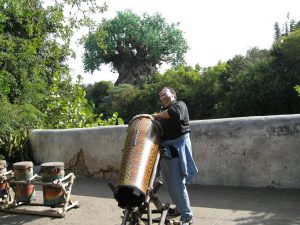
Ben was doing his best Ricky Ricardo impression. 2007
“He lives in you.”- Rafiki, talking to Simba about Mufasa
“Oh yes, the past can hurt. But from the way I see it, you can either run from it, or learn from it.” – Rafiki
“Remember.”- Mufasa
Without a doubt, I see within myself reflections of my mom, dad, grandma and Ben. The love we shared, who they were and my experiences with them- particularly as a caregiver for my dad and Ben- have shaped me. Caregiving was challenging and at times downright ugly, but I don’t want to run away from or pack away that time, because what I learned from those experiences and memories is profoundly meaningful and indescribably loving. Now, I want to make my loved ones proud and I want them to know through my actions that they are remembered and loved in every step I take.
In honor of Ben’s love of this film, here’s a pic of him with one of his best buddies during our visit to Walt Disney World in 2014.
With every Disney film release come thoughts of Ben, but a film like The Incredibles 2 is particularly bittersweet because of Ben’s love of the original film. Mr. Incredible was one of his top three Disney buddies, along with Buzz Lightyear and Sully. Because of this, and since it was our tradition, it was especially important to me to see the film on opening day.
Of course, I had my little cry in the theater as the film began. There are times when I literally feel Ben beside me, which I know some people find strange, but at this film I didn’t feel his presence. I did, however, profoundly feel his absence. I was angry that he did not have the chance to see this movie. I don’t usually feel angry, though I do often feel frustrated that he was cheated of so much of life. There are certainly more profound life moments that he is missing and will miss that I should probably be more angry about, but sometimes the little moments make a tremendous impact.
This blog is a clear reflection of the way I look to each Disney film for enlightenment, hopefully a quote that will carry me forward or give me perspective. I like to be able to share these thoughts with other caregivers with the intention that they will validate, inspire or comfort. The Incredibles 2 did not disappoint. The film actually has a lot of messages about inclusion, diversity, fighting for justice, family and love. There were audible expressions of agreement when Dicker said,“Politicians don’t understand people who do good things. That makes them nervous.“
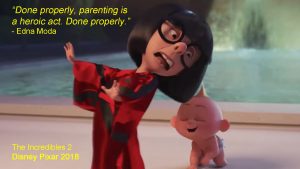
Interestingly, the quote that resonated with me was very appropriate for caregivers, and for an opening weekend that included Father’s Day. Edna Moda told Mr. Incredible,“Done properly, parenting is a heroic act. Done properly.” I was so fortunate to have had two devoted and loving parents. As a public school teacher, over the years I have seen many children who are not parented properly, in fact, they are barely parented at all. Good parenting is indeed a heroic, selfless act of love. The same came be said for good caregiving.
As a caregiver, I often questioned my abilities, especially when I was struggling with exhaustion, sadness and patience with Ben when he was stubborn and demanding. But, like any other caregiver, I put my emotions and feelings aside, or, at least on hold, and trudged on because the immediate needs of caregiving are not negotiable. Phone calls abruptly ended, activities were thrown to the side, chores ignored (well, I can’t say I minded that very much) as I attempted to create order amidst chaos, calm when he was panicked, and peace amidst the devastation of watching Ben deteriorate and suffer, physically and/or emotionally. Like all caregivers, I also ran interference among medical professionals and other related staff, as well as family and friends. I provided spirit boosts and levity and also administered difficult doses of reality, as tactfully as possible.
It certainly wasn’t my goal as a caregiver to be heroic and I don’t think that caregivers generally perceive themselves as heroes. We probably spend more time following Dory’s advice to “just keep swimming.”As a crybaby, I’ve never seen myself as heroic- at any point in my life- which is why, I think, I was puzzled when people told me that I was brave. Ben was brave, I was along for the ride, trying to be helpful and, a good deal of the time, not sure if I was much of a success. My insecurities made me feel much less than a superhero. However, I can attest that I definitely earned the Wonder Woman t-shirt Ben got me after I managed to grab him and keep him from falling off the bed!
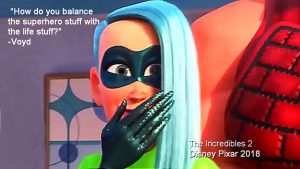
In the film we are introduced to new super hero, Voyd, who asks Mrs. Incredible/Elastigirl, “How do you balance the superhero stuff with the life stuff?” Indeed, that’s a very important consideration for caregivers. For me, I constantly struggled with balancing the responsibilities of caregiving against a full-time job, daily life chores, relationships with friends and family, the emotional strain of losing the life Ben and I had, and knowing that ultimately, I was going to lose Ben. In retrospect, I think the balancing act IS the superhero stuff.
Young Dash tells his dad, Mr. Incredible, that he wants to fight bad guys because “It defines me.” I can say that caregiving defined me for several years and I found that it is a significant part of who I am and how I see myself. I have written about how I floundered when I was no longer a caregiver, until I found myself again through blogging, volunteering and trying to support other caregivers. Although I would rather not have discovered this through the illness and loss of my dad and Ben, I feel like I have identified caregiving as my super power. Unfortunately, I was not able to defeat cancer or ALS, but my dad and Ben always felt cared and advocated for and loved, and that is incredibly powerful. I did not see it while I was actively caregiving, but time and distance have provided valuable perspective.
Mr. Incredible at Walt Disney World’s parade, 2014.
Mr. Incredible summed up well the life of a caregiver when he said: “How do I do it? By rolling with the punches, baby!” I can picture Ben smiling and nodding, because, in actuality, both he and I rolled with the punches. I am still in awe of how well he rolled with the severe punches dealt to him by ALS. I guess we were both super heroes, albeit without the cute costumes.
I highly recommend The Incredibles 2. It’s quite fun and fantastic and offers unexpected words of wisdom for caregivers and everyone else. Post your thoughts! I look forward to reading them.
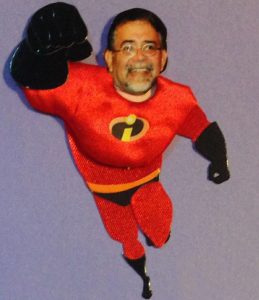
Ben as Mr. Incredible- Part of a birthday collage that I made for Ben. When it came to battling ALS, Ben was indeed a super hero!
Donald Duck’s birthday prompted me to revisit the post I wrote on this momentous occasion last year. At the time, with summer vacation right around the corner, I was propelled into the heartbreaking memories of debating with Ben how his caregiving would be done when school let out, and having those arguments negated because the summer of 2015 was spent at the hospital, where Ben ultimately succumbed to ALS. Those difficult memories have cropped up again as summer approaches. Since I read last year’s post, I have been reflecting on how my grief has shifted over these three years.
In 2016, as the first summer without Ben approached, I felt overwhelmed by the devastation of reliving every moment of time leading up to and including Ben’s time spent in the hospital, in which the end of summer coinciding with the end of his life. Of course, firsts are always difficult. I was consumed with worry about how I would feel during my first summer in many years without any caregiving responsibilities and without school as a distraction. Caregiving was pretty much the only thing on my mind, so I compiled my journal of Disney quotes and started writing this blog, which was actually very helpful as I sorted through the experience. It gave me a sense of purpose to think that maybe my words and experiences would help other caregivers. This, in itself, was an enlightenment. Although I wished that Ben had never had ALS and needed me as a caregiver, I found that I am a caregiver at heart and I am most content caring for and helping others. Unfortunately, sometimes this has proven to be a convenient way to avoid taking care of myself, but that’s a whole other blog! Since going to the theater is my favorite activity, I got tickets for all of the Broadway shows I had been wanting to see. I was excited at the prospect of seeing the shows, but, once there, I found that I could not truly enjoy myself. I missed Ben. I felt guilty about doing things that I couldn’t do when I was taking care of him. I had a lot of guilt about living my life when he was no longer here and we couldn’t not enjoy our life together. Although I had the freedom to do things, I did not feel the zest of “reclaiming” of my life that people told me I should feel. I wanted Ben to be here. I socialized more, but Ben was really the only thing I wanted to talk about. After outings, I often returned home in tears because home was so lonely without Ben. I went through motions, trying to convince myself that I was doing fine, but fighting myself often led to feeling worse. The fact was that embracing my life felt daunting, wrong, and somewhat impossible.
I spent that first summer dreading and planning how to spend the first anniversary of the day Ben left this world. I decided to make a video tribute to Ben for the blog and I pored over our photographs and videos. It kept me very busy and made me feel good to do this for him, for us. I bought a couple of computer programs to help me with the task, taking pride in the knowledge that Ben would have appreciated my mastery of the software. The anniversary day came with many tears and my keeping a low profile, except for sharing the video with friends, family and some of the special people who took care of Ben. I remember that the day after that anniversary was almost worse than the actual day. I spent so much time bracing myself for that anniversary, anticipating the sadness, making a plan to honor Ben. The next day, I was lost and I was miserable. I was unsure of how to act. Would people not want to hear about Ben and my grief anymore because that one-year marker had passed? What was appropriate in terms of talking about him? What was “healthy?” I knew enough to ignore the people who told me what I “should” or “had to” do, but I didn’t have any answers of my own. I’m a person who wears my heart on my sleeve, and I just had to let my life unfold, understanding that there would be good and bad days ahead.
The second year passed- I became more immersed in supporting other caregivers, particularly those caring for people with ALS, through my blog and various online support groups. I embarked on a certificate program to become a caregiving consultant. I did a lot of reflection and realized that I am most comfortable defining myself as a caregiver, so losing my dad and Ben also signified the loss of much of my identity. In many ways, the second year of grief was harder than the first, because the first year becomes such a fog and the loss is new and raw. In the second year, it seemed like I felt the sadness more intensely. Since I had formed some new routines, when a wave of grief hit me and threw me off course, I had a very hard time getting back on track. There was a constant loneliness, even though I was surrounded by people whom I love and who love me. I assessed everything I did, trying to prove to myself that I was respecting Ben, grieving appropriately, and coping well with life. The truth was that although I was active, going to the theater, seeing friends, writing, volunteering, and I even created a profile for online dating, I was also floundering. I was tiptoeing in the world of the living without really delving into it.
It was during that second year, last June, when I wrote Donald’s birthday post, and I could not shake all of the memories of the summer of 2015, when Ben went into the emergency room and everything changed. I found myself wondering if I was grieving too much, crying too much, dwelling on Ben too much. Still, I was determined to have a productive and positive summer and take grief with me. I made plans to travel to spend time with good friends, something I had not been able to do for several years. I was excited about it, and I did have a wonderful time, but Ben still had a huge presence. I talked about him frequently and kept him close, which sometimes made me miss him even more. I even bought things simply because he would have liked them, bringing them home only to face the obvious truth that he was not really here to enjoy them and then dealing with another setback. But, I have only come to understand in retrospect that I could not venture forth without him.
On the second anniversary of his “leaving,” as he called it, I reposted the video I made the year before. I decided to stay home and keep a low profile. Sadly, as it turned out, I had to attend the funeral of my best friend’s mother, who was often like a surrogate mom to me. It was a day of loss and tears but also of thinking of good times.
This year, heading towards the third anniversary of Ben’s passing, I am facing the summer with less dread. I still think of this time of year in terms of the markers of Ben’s battle with ALS, and I drift back to those memories and give into the bouts of sadness, but as Dory taught me, I just keep swimming. I accept that this time of year will probably always have a tinge of melancholy. However, with more enthusiasm and confidence, I once again made plans that I am looking forward to. I do not feel the same level of guilt about enjoying my life, although I still grapple with the knowledge that adventures would be better if Ben was still here. Some of my plans include things that Ben and I wanted to do together, like a penguin encounter at the Georgia Aquarium. I’m a little wary about it because it stands to be emotional, but I also want to honor our relationship and the things that were special to us. I guess the positive thing is that I am not letting grief or guilt hold me back from living. I am not yet comfortable being on my own, and still often refer to Ben and our life, but I am out in the world having new experiences. Maybe on some level keeping him so close keeps me in our relationship, but I fully believe in my heart that Ben is always watching over me, which gives me comfort. But, I am also creating new wonderful memories. I am not worrying- at least not yet- about how I will spend the third anniversary of Ben’s leaving. I have come to realize that I cannot plan my emotions. The day may be easier or harder than I anticipate. I will let my heart guide me and not fight myself. There will be no right or wrong about what I choose to do or not to do. As I reflect on the past three years, I see that I have learned to coexist with grief as I respectfully give grief its time.
[bctt tweet=”As I reflect on the past three years, I see that I have learned to coexist with grief as I respectfully give grief its time.”]
I would not have predicted that Donald Duck’s birthday would provide an opportunity for reflection and insight into my grief, but reading my post from last year and once again poring over our photographs, with a combination of smiles and tears, let’s me know that I am doing ok. I still cry, I still feel sadness, I still miss Ben, and I am okay with that because those feelings speak to the wonderful times that we have over sixteen years.
Donald Duck hangs out in the Mexican pavilion at Epcot but I don’t know how much Spanish he spoke!
The Disney magic must never be underestimated. When we were at Walt Disney World, Ben and I stepped into a carefree fantasy that helped us to, at least momentarily, transcend the challenges of ALS. Our photos, some of which I share here, were so important to Ben as his ALS progressed. He loved to relive the healthy days, but he also examined his physical changes as a result of ALS. The photos were essential to me in the early stages of grief, particularly when I wanted to keep him as close to actually being with me as possible. They remain a treasured and positive part of my dealing with the rough times of missing him. I never lose sight of how lucky we were to have a special love and to share this love of Disney that always shed much needed pixie dust on our lives. Donald is part of those special memories that comfort me.
So, with gratitude and joy, I say Happy Birthday, Donald Duck.
When I think of Goofy, I can’t help but remember all of the fun times that Ben and I had with him. Of course, he’s always a lot of fun. But, we learned that there is a whole lot more to his Disney magic than silliness. Goofy was a big dose of comfort to Ben during our last visit to Walt Disney World.
Meeting our Disney buddies was always fun, especially for me, but after Ben’s ALS diagnosis, seeing them, especially Mickey Mouse, became very emotional. Although Ben traveled around the parks in a scooter and then an electric wheelchair, while he still had strength in his legs, he stood up for photos with Mickey, Minnie, Pluto, Goofy and Buzz Lightyear. As his legs weakened, he still tried to stand for Mickey and Minnie. A couple of times, Mickey even helped me to help Ben out of the chair and he escorted Ben to the photo spot. During our last trip, in 2014, when Ben would not stand at all, I knew he had truly weakened. Living with him, you might think that it was obvious that he had deteriorated, and of course you would be correct. However, Ben admitting that he could not stand to meet Mickey was symbolic of his surrendering to ALS and that our life was never going to be the same. It was an overwhelmingly sad and emotional meet and greet, with Ben and me in tears. Mickey had hugs for both of us and I asked him for some magic. With a diagnosis like ALS, you just want to believe in that magic.
It was actually Goofy who picked up our emotional pieces. He saw me trying to comfort Ben and he knelt down next to Ben, being his Goofy self, and soon enough, Ben was laughing. He hugged Ben, he danced around, and Ben was back in the magic. Goofy knew just what to do and there was nothing Goofy about that!
Thank you and Happy Birthday, Goofy! You are 86 years young, and a forever friend.